One imagines Francis Bacon was not a guest any best man would want to see at a wedding. Sitting there, watching, doubting, sipping water, immune to the slapstick gags and tall tales of the groomsman’s life. The father of empiricism would think it all rubbish. Not true. That the best man was misleading the guests, losing them, taking fragments of truth and then spinning them into stories of pure fancy. Throw in a free bar and a dim view of the DJ and who knows where it would end. Tough man. But then if you had started at Trinity College, Cambridge aged twelve, there likely hadn’t been much time for fart machines, marshmallows or shits and giggles.
It was at Cambridge where Bacon fell under the high-brow care of one John Walsall, an Oxford man, who exposed the inquisitive boy to puritanism, the bearded movement that sought to rid the Church of England of everything Roman Catholic. One imagines, had there been social media in the 16th century, the trolling would have been on an eye-popping scale, such was the frustration with the limited impact of the Reformation, and the Church’s wider tolerance of all things, well, Roman Catholic. It was at Cambridge where Bacon also first met Queen Elizabeth, who would go on to have a significant influence on his life; and Aristotle, who he never met, but whose philosophy he devoured, albeit concluding it was somewhat “barren”. Tough crowd, indeed. And what did our man do after Cambridge, you mutter? Well, Bacon headed to Poitiers.
Now Potiers has some form. Today, the city is home to just shy of a hundred thousand French, all garlic breath and miffed expression; it is also a city of art and history, known locally as the “ville aux cent clochers” which poses little difficulty for even the C-leaning GCSE student: “the city of a hundred bell towers”. What drew Bacon to Poitiers was its university, a university that hosted other big-ticket thinkers like Francois Rabelais, the father of French prose; and Joachim du Bellay, the poet and founder of Pleiade; a group of itchy critics who set about promoting French as an artistic language equal to both Greek and Latin. Today, Poitiers is a convenient overnight stop for pink Brits driving down to the heat of the South, but in 1356 it also hosted one of the bloodiest, and significant, battles of the Hundred Years’ War; a battle called, with true GCSE flair: The Battle of Poitiers.
Since the Norman Conquest of 1066, English monarchs had long sat on titles and acres and acres of lush land within France, which made them – as sticky as it sounds – vassals of the French monarch. A vassal, or liege subject, is a person regarded as having a mutual obligation to a lord or monarch. The subordinate party, in this such set-up, was the English monarch, hence it all being a bit awkward. By the early fourteenth century, the only significant land left under the control of the English monarch was Gascony. Cue a sharp intake of breath from anyone on the mailing list Berry Brothers & Rudd. For the capital of Gascony was Bordeaux, and duty levied on the wine coming out of Bordeaux was, by a considerable amount, the largest source of state income. This got
the goat of Philip VI of France, who decided he wanted it back. Cue the start of a war that would last one hundred, and sixteen years.
Roll forward to 19th September 1356, nineteen years after the whole thing kicked off, and one King John II, or John the Good, was fronting up against an Anglo-Gascon mob under the frosty gaze of Edward of Woodstock, aka The Black Prince, the eldest son and heir apparent of King Edward III. The battle itself, five miles to the south of the clock towers, reads like a Merseyside derby in the days of Kevin Sheedy and Steve Nicol. Nip and tuck. Attack and counter. Ebb and flow. Fighting entirely on foot, the up-for-it Anglo-Gascons repulsed one frantic French attack under the cool command of John’s son, Charles the dauphin and then, as confusion ripped through the ranks, gained the upper hand capturing, in a move that would have any half-time pundit drooling with delight, all four of John’s sons. Bingo.
What followed was a few more, increasingly puffed out assaults by the French. And yet, with a sixth sense the Anglo-Gascons were also wearing it, high command gave down the order to unfurl the French sacred banner, the Oriflamme, signalling that the gloves were off: no prisoners were to be taken. A fight to the death. With fire roaring in the belly, knowing that they would not have the extra work of taking prisoners, the French slowly gained the upper hand. Momentum turned. And then, like a goal against the run of play, up popped a small, mounted force of about a hundred and sixty men who had been told to circle back around and attack the French from behind. Quite what they had been doing all this time is not recorded, but up they popped. With the sun below the yard arm, limbs weary, and minds frayed, and what with all the mud and blood and groaning bodies, this caused panic. Blind panic. The French thought they were surrounded. Some started to leg and, like a flock of Ayrshire sheep, the rest followed. By the time it takes to puff through a tar-laden Gauloises, it was all over. The entire French force collapsed.
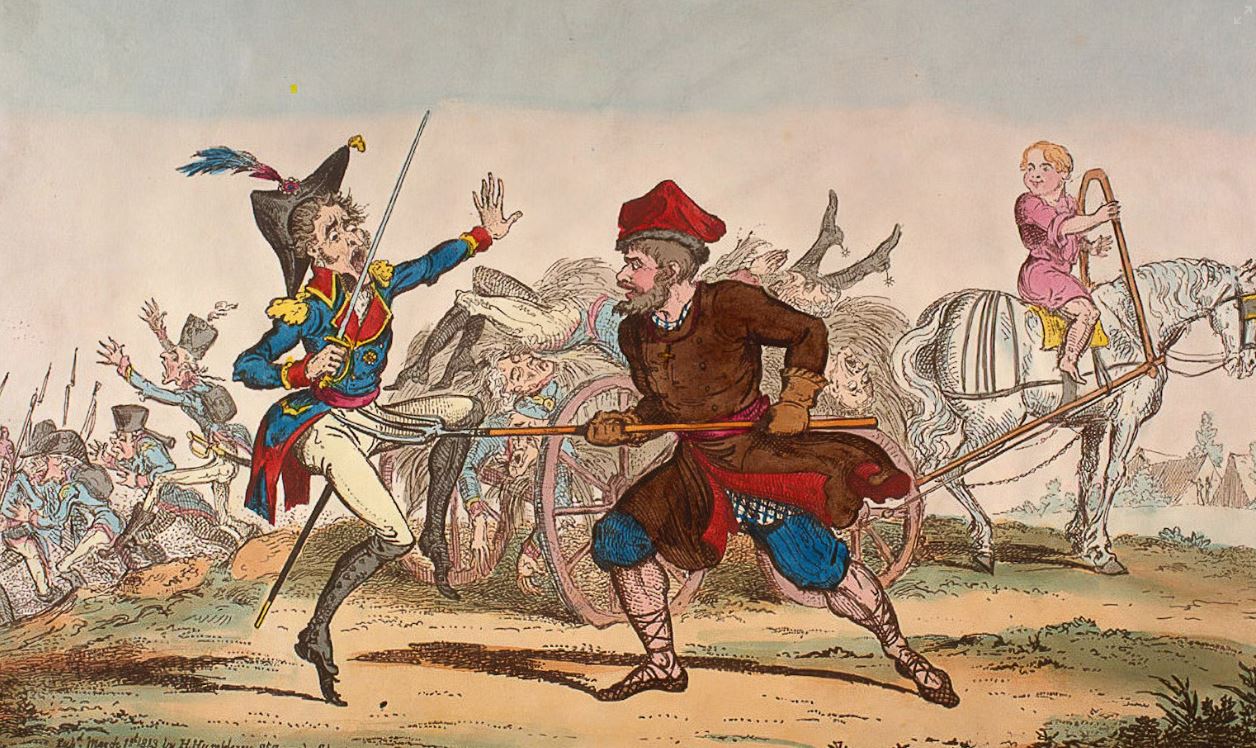
John was captured. Three thousand men died. With the rest of the French army hiding under hay in isolated barns, the euphoric Anglo-Gascons headed back home: “One man went to mow, went to mow a meadow…one man and his supersonic sausage dog etc, etc” Eventually an uneasy truce was brokered, and the Black Prince took John back to London. Not knowing what else to do, the French took to the streets, and rioted. The ransom of John dragged out. Eventually Edward rounded up some men and launched another campaign in 1359 which eventually saw both sides begrudgingly sign the ‘Treaty of Bretigny’ which saw vast swathes of France ceded to England. John was finally ransomed for three million gold ecu, a coin minted during the reign of Louis IX.
Game over?
Not quite.
Miffed at the loss of territory, the French had another crack ten years later and recaptured pretty much everything they had lost.
The long slog of the ‘hundred years’ war, eventually ended, in 1453.

 Hepburnsays