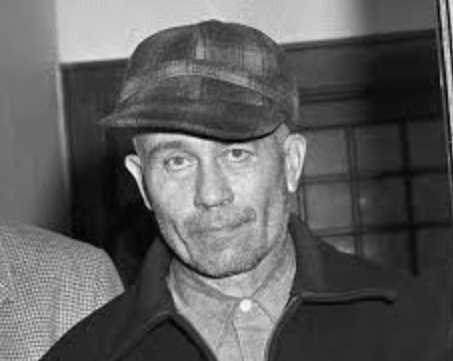
On the morning of November 16th, 1957, Bernice Worden disappeared. Bernice ran the hardware shop in Plainfield, an unremarkable town in rural Wisconsin. It was deer hunting season and so locals thought nothing of the ‘CLOSED’ sign hanging in the door all day, although one curtain twitcher later recalled seeing Bernice’s pickup fishtailing it out of the car park around 9.30am. Bernice’s son, Frank, a flinty eyed Deputy Sheriff, popped by at about 5pm to check up on her, but the shop was still closed. On entering he found the cash register open; and empty. He also found blood on the floor. With a well-honed nose for trouble, he checked the sales register to see what, and more importantly, to whom, the last item was sold. His eyes then grew large. The name. ‘Sweet mother of God’ he mumbled and then fumbled for his radio: “We have a live one!” The last item sold was a gallon of anti-freeze, and it was sold to a local recluse and odd-job man called Edward Gein. It was the last gallon of antifreeze Ed Gein would buy as he was picked up in a grocery store and arrested. When they searched his farm, they soon found Bernice: hanging upside down in a shed, with no head. She had been shot with a .22 calibre rifle.
And it didn’t stop there. They started to poke around and soon found bones. Lots of bones. They also found a wastebasket made of human skin. And skulls on bed posts, and a belt made from female nipples, and a pair of lips on a window shade draw-string and lots of female fingers. They found four noses and a shoe box full of, you know what, forget it. You don’t want to know. They found enough to make any defence lawyer close the file, dump it on a colleague’s desk and head to the club for a whisky and soda. When questioned Gein just shrugged his shoulders and said that after watching the news, rather than go to bed; he’d pull on his wellies, grab a spade, and go and dig up graves. Bad man, you mutter. Indeed, a very bad man, but first you may want a bit of background.
His father George, was an alcoholic. His mother Augusta, a complete lunatic. The family lived, along with his older brother Henry, in isolation on a 155-acre farm on the outskirts of Plainfield. Growing up Gein only really left the farm to go to school. There were no play-dates, no sleepovers and no parties. His mother ensured he had no friends, indeed, she punished him if he ever tried to make one. His days, then, were spent mucking out the horses, hanging laundry and creosoting the fence. His mother was also religious, a Lutheran, a branch of Protestant Christianity which identifies with the theology of Martin Luther, a German friar. And his mother loved it. Whenever the boys weren’t mucking out horses, hanging up laundry or creosoting the fence, she would have them sitting cross legged on the kitchen floor where she would yell at them about the immorality of the world. She would warn them off liquor and whisper that all women were prostitutes and instruments of the devil. She did not take questions.
When Gein’s father died, he started doing odd-jobs around town with his brother to help pay the bills. Initially they were accepted by the community. Yes, they were odd, but they were also reliable. Gein even started doing some babysitting for some neighbours. Soon though, his brother started dating a divorcee and planned to move in with her. He also started to bad mouth their mother. Doing this in front of Edward was, with hindsight, a grave error. One day the brothers were out burning some vegetation on their farm when the fire got out of control. The local fire brigade was called and soon had the blaze under control. Later that night with the fire extinguished and the fire fighters at home having their feet rubbed, Gein reported that his brother was ‘missing’. The local Sherriff scared up a search party and they set out with lanterns and flashlights to look for him. They soon found him. He was lying face down in some undergrowth not far from the tractor shed. Given his body was not burned, it was quickly assumed he had died of heart failure: despite Gein looking on with a vacant expression, leaning on a spade. The police thought nothing iffy of it, and the coroner for lack of any other obvious cause and a dinner-date to make, ticked asphyxiation, as the cause of death. No autopsy was ever performed. It was all very Chief Wiggum.
Soon after his brother’s ‘heart failure’ Augusta had a stroke, and Gein dedicated himself to looking after her. You can imagine she was not an easy patient. One day, they popped over to a neighbour to buy some straw. When they got there, for whatever reason, the neighbour, another lunatic named Smith, started beating his dog. And he didn’t stop. A woman ran out of the house and yelled at him to stop. But he didn’t stop, he continued to beat the dog, to death. Augusta was visibly upset by this. Now get this: she was upset not because she had just seen a little pooch being clubbed to death by a mad man, but because of the appearance of the woman. Smith and the woman were not married. “SLUT!” she yelled with spittle and watery eyes, as Gein mouthed a “Thanks for the straw” and drove away down the drive. She was clearly holding on quite tight, and soon after that God called time. She had another stroke and died shortly afterwards. Having lost his mother, it appears this is when Gein started digging up graves to create a ‘woman suit’ so that he could become his mother. Yes, you read that bit right: a woman suit. The capacity of human beings to surprise never ceases to amaze.
Gein pleaded not guilty on account of being mad. He was packed off to a mental hospital. Doctors later decided he was fit to stand trial and his sheepish defence lawyer asked for the trial to be held without a jury. It was all on the judge. The judge read up until the lips on curtain draw string bit and then slammed his gavel down and declared Gein guilty. He then faced another trial to deal with his sanity. The same judge still thinking about the curtains, declared Gein completely insane and sent him back to the mental hospital where he died, twenty five years later.
Alfred Hitchcock’s 1960 film, Psycho, is based on the fictionalised account of this sorry tale.
All in, a pretty nasty affair.

 Hepburnsays