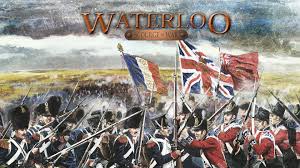
The historian Andrew Roberts once muttered over a buttery scallop and crisp glass of white Burgundy, that it was “a curious fact about the Battle of Waterloo that no one is absolutely certain when it actually began.” Arthur Wellesley, aka the Duke of Wellington, after a sleepless night had eventually risen at 2am and, with a cup of tea to hand and lamps burning, had been busy writing letters, firing off bulled up missives to Field Marshall Prince Blucher, whose Prussian forces had recently been smoked by the Napoleon Bonaparte at the Battle of Ligny. By 6am Wellington was on the battlefield moving his forces into place like a vexed Jose Mourinho. Bonaparte, by contrast, had a lie in and took breakfast on a silver platter before telling his gathered generals that Wellington was a “bad general” and that the impending battle was “nothing more than eating breakfast”.
Whilst the exact timing is in doubt, the day is not: Sunday 18th June 1815. Nor are the players involved. There was Wellington, sweet talking a multinational army into chainmail on one side; and Napoleon’s famed Armee du Nord on the other. There was then the Prussians, under the steely command of Blucher. The Prussians, after tasting mud in Ligny, had beaten a hasty retreat to Melioreux and spent a couple of days chewing paracetamol and bitching about the French. With dry boots and Wellington’s syrupy words ringing in their ears, Blucher then led them back into battle and, with what was possibly a spittle flecked, wide-eyed ‘Bonjour mes amis’, swung the bloody fracas the way of the allied coalition.
But first, you must be wanting some background. After all, Waterloo was in Belgium, a country long dark chocolate and hoppy beer, short aggression; and Napoleon had one of the finest military minds, with an impeccable record of warmongering. Well then…
….when Napoleon Bonaparte first stepped into the tight felt strides of the First Consul of France in 1799 he inherited a loose and chaotic Republic. Demonstrating qualities that would sit well today in organisations such as Goldman Sachs, he quickly sorted out it all out. Soon France had stable finances, strong bureaucracy and an army looking for a fight. Cue the string of Napoleonic wars that ended with the Seventh and final brouhaha at Waterloo.
The warmongering was on account of a potent mix of ambition, high public approval ratings and a taste for a scrap. After he became Emperor in 1804, the relationship with the British was tetchy at best. Insults flew. Contempt filled the channel and, after Napoleon had crowned himself with the Iron Crown of Lombardy – one of the oldest royal insignias of Christendom – and slotted the much liked Duke of Enghien, the rest of Europe quickly agreed with the British. Very soon Napoleon found himself lined up against the somewhat sticky alliance of the Roman Catholic Church, Russia, Britain and a few others, in the War of the Third Coalition. This he won and in doing so, polished off the Holy Roman Empire.
Two years later, he was up against the Fourth coalition made up of the same opposition, with Sweden stepping in for the disillusioned Roman Catholics. This he also won and, in doing so, snaffled Berlin and a whole lot of Prussia, leaving France in charge of pretty much Western Europe, bar the olive groves of Spain. As you might imagine this did not escape Napoleon’s avaricious gaze and, with his army rested and ammo belts full up, he soon had a go. This resulted in the Peninsular war, a sweaty six-year affair, significant for the emergence of large scale guerrilla warfare. As the Iberian peninsular resonated with the pop-pop of artillery, another coalition – this one the fifth – found enough soldiers who had not heard of the first four, and had another run at the French, this time rolling over in a bloody struggle at Wagram, in north-east Austria. Having been beaten back in Spain, Napoleon quickly turned his eyes to Russia, who had long-grumbled at the economic consequences of his new regime, and decided to invade the mother country. This proved to be a step too far and thoroughly fed up with the French, the allies fought hard and drove Napoleon back out of Russia, out of Germany and then with their tails up, they ran on and invaded France, finally taking Paris. Cue grins all round. Forced to abdicate Napoleon was exiled to the island of Elba. Knowing his reluctance to take orders and keen to see the back of him, the allies said that the island was now his and he could still make people call him Emperor.
Napoleon very quickly sorted out Elba – think new roads, new legal system – the works. A few months in though he heard that his wife had died. He also heard some rumours that he was about to be sent to an even smaller island in the Atlantic and so slipped his guard in Elba and escaped with seven hundred men in the brig Inconstant, both of which, for some reason, he had been allowed to keep. Marching on Paris, Napoleon soon met the 5th regiment who had been dispatched to take him back to Elba. Having made contact just outside of Grenoble, Napoleon dismounted his horse, and strolled up to the loyal troops of Louis XVIII and shouted “Here I am. Kill your Emperor if you wish.” Say what you like about him, but he had some form. The soldiers of the 5th regiment, looked at each other, looked at Napoleon, muttered something along the lines of bugger this and shouted back “Vive L’Empreur”. They then all marched on Paris. Louis XVIII, having seen the loyalty of a French solider in action, threw some clean undies into a bag and legged it Belgium. With no opposition, Napoleon arrived in Paris and governed for a period now known as the Hundred Days. The powers of the Congress of Vienna – a collection of polished European ambassadors who were trying to draw up a long term peace plan for Europe – took a dim view of all this and declared Napoleon an outlaw and, a few days later, by now royally peeved at his belligerence, Europe mobilised once more to teach the man one final lesson. And that roughly gets us to Waterloo.
Waterloo offered Wellington a good spot to do battle. There were ridges and sunken roads and a large elm tree which served as his command post for much of the day. Heavy rain delayed any action, but soon Napoleon was on the march, picking off the allied defences at Hougoumont, in the hope of cutting off Wellington’s communication with the sea. The fighting was to last long into the evening. At about 1pm the French infantry got into the action and the real skirmishing started. There were Dutch militias, Hanoverian troops and bucket loads of British. The fighting was fierce, fortune ebbed and flowed but by 3pm the exquisitely named Baron von Muffling – a Prussian liaison officer attached to Wellington’s army – was beginning to panic. He later wrote “the Duke’s situation became critical, unless the succour of the Prussian army arrived soon”. Enter the British cavalry who charged, as they were prone to do. According to Wellington: “Our offices of cavalry have a acquired a trick of galloping at everything” which is just the sort of cavalry you want in battle. Cue French losses and very soon some puffed out Scots greys. Not to be out done, by 4pm the French cavalry struck back. Captain Gronow of the Foots Guards described “an overwhelming, long moving line, which, ever advancing, glittered like a stormy wave of the sea when it catches the sunlight”. The French cavalry, though, lacked the artillery back-up, and after many attacks they too were spent. In came the French artillery, and it was here they started to make some progress, pulverising the opposition and advancing on Wellington’s elm tree. They took Lay Haye Sainte after the Germans ran out of ammunition and the situation grew dire; so dire that Wellington later wrote: “The time they occupied in approaching seemed interminable. Both they and my watch seemed to have stuck fast”. As eyes started to widen and the word ‘retreat’ mouthed behind Wellington’s back, the Prussians finally arrived and it was squeaky bum time for the French.
It seems by this stage everything was somewhat chaotic, the battlefield littered with smoke and bodies and lots and lots of skirmishing. With the sun long passed the yard-arm, Napoleon rolled the dice by putting into play his crack-ass, hitherto undefeated, Imperial Guard infantry. There followed one of the most celebrated passage of arms in military history involving attack, counter attack, surprise, confusion and an old fashioned bayonet charge. Eventually, after the 52nd Light infantry led by John Colborne, poured a devastating volley of lead into the enemy, the chasseurs broke rank. With panic spreading through French lines Wellington climbed up into the stirrups of his trusty steed Copenhagen – named in honour of the British victory at the Second Battle of Copenhagen – and waved his hat in the air, the signal for a full blooded attack. The retreating French were chased into the falling dusk and routed.
Louis XVIII was once more restored to the throne and Napoleon was packed off to Saint Helena where he died six years later, cold and lonely, and perhaps ruing the reckless ambition of his youth.
The Battle of Waterloo has long been seen as significant turning point in the history of Western Europe ushering in a period of relative stability, material prosperity and technological progress. There would be no major conflict until the Crimean War some four decades later. That though is, another story.
A bit long this one, but no easy job doing the Battle of Waterloo in a thousand words.
Epic, on so many counts.

 Hepburnsays