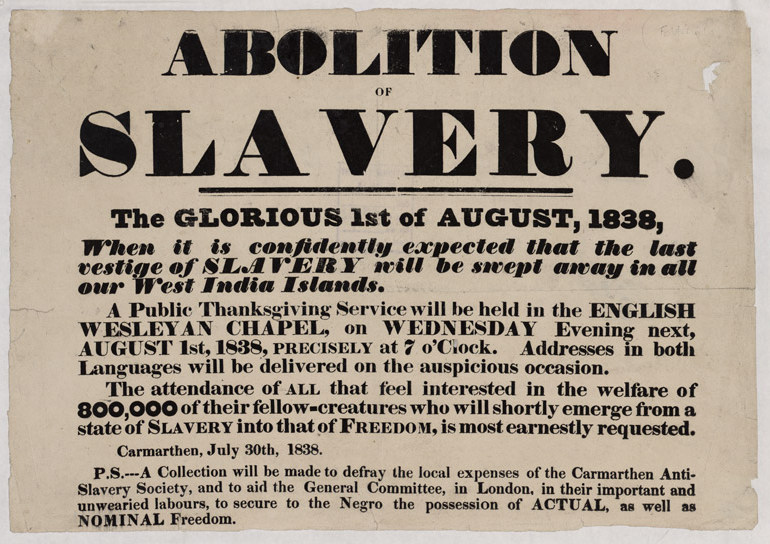
Given their propensity to hug strangers, dress in shabby clothes and go white at the offer of a bayonet and spot of warmongering in France, it will come as little surprise that the Quakers were big supporters of the abolition of slavery. We may all choke on their self-restraint over the drinks trolley but when it comes to slavery, it is fair to say they were spot on.
Slavery has been around a long time, and existed in many cultures long before the existence of written history. Abolitionism is the formal term that describes the movement to end slavery, and is usually associated with the effort to end the African and Indian slave trade. To the surprise of many, it appears it was the French who led the way. In 1315, Louis X, also called Louis the Quarreller, Louis the Headstrong or simply ‘le hutin’ which roughly translates as ‘stubborn bastard’, published a decree announcing any slave setting foot in France was free. Whoop whoop. Indeed. Louis’ reign was, though, a short one and remembered, aside from the slavery stuff, as being one that was full of feuding with noble factions. There was the added issues of his wife, Margaret of Burgundy, who had all her hair cut off and was locked up for the seemingly innocuous French pastime of adultery. How times change. Margaret later died in prison, allegedly strangled by the prison strong man to allow the King to re-marry, which he swiftly did. Louis married Clementia of Hungary, who was actually born and brought up in Naples but why let that get in the way of a good name. Louis himself then died of pneumonia before the birth of his daughter, petit Joan, later Joan II of Navarre, although there were whispers that his white wine had been laced with poison. What goes around comes around.
Now, whilst slaves were free in France, they still had obligations in the overseas colonies where they kept the sugar cane plantations free of weeds. King Louis’ decree, appropriately called le code noir, redefined the role of the slave giving the downtrodden unparalleled rights. These included the right to marry, the right to gather publicly and the right to have a lie in on a Sunday. It also banned slave owners from thrashing their workers for poor posture and separating them from their family. Owners were also forced to instruct them in the Roman Catholic faith, an important point in that it implied that slaves were endowed with a human soul, albeit at the cost of cutting short Sunday’s lie in. The Code noir also banned inter racial marriages, which appears to have been somewhat ambitious given the obvious appetite of many a French colonial plantation owner for a quick a fumble in the tractor shed.
Another notable opponent of slavery was the great British philosopher, political economist and all round ‘influential thinker’, John Stuart Mill. As he might well have been given he penned On Liberty, a tome that addressed the nature and limits of power that can be legitimately exercised by society over the individual. ‘Despotism’ he would tell his supper guests over a plate of ripe brie, ‘is a legitimate mode of government in dealing with barbarians’. The port often ran dry.
As you imagine for a man who contributed so much to the high-brow chitter chatter of philosophical debate, Mill was a precocious child. His childhood though, was not one parents should perhaps seek to replicate. He was taught Greek aged three. By eight, he had read Aesop’s Fables and was familiar with Isocrates, one of the most influential of Greek rhetoricians, and had ploughed through six dialogues of Plato. He quickly moved on to learning Latin, with evenings spent buried in the works of Euclid. Yes Euclid of Alexandria, aka the founder of geometry. By ten he was fluent in both Greek and Latin. His father, seemingly unhappy with his son’s progress, thought it was important for Mill to then study and compose poetry. At twelve the young lad was deep in the study of scholastic logic. At fourteen he headed to France. This, though, was no pen pal exchange of buttery croissants and nudist beaches for Mill was sent to Montpellier and the Faculte des Sciences for courses in chemistry, zoology, and logic. By twenty Mill found himself in a proper stew as he was unable to answer the question of whether the creation of a just society, essentially his life’s objective, would actually make him happy. His heart told him no, and he started to think about suicide. Fortunately he was saved by the poetry of William Wordsworth. Having picked up a copy one wet weekend he realised that beauty generates compassion for others and stimulates joy. Mill was back in the game; much to the benefit of slaves, particularly those slaves circa 1850, when he famously attacked Thomas Carlyle’s essay Occasional Discourse on the Negro Question. Mill: good egg.
Whilst Mauritania was the last country to outlaw the practice of keeping the cleaner in the airing cupboard, ashamedly as late as 2007, there is still estimated to be around 45m people who are ferried about in the back of lorries by men with guns and SIM only mobile phones. Trafficking people, unfortunately, remains big business. Indeed the International Labour Organisation believe that forced labour generates more than $150bn in annual profits and is one of the areas of keen strategic focus for many a criminal organisation which is a somewhat dispiriting point to end on.
And Love Island has finished.
Gin time.

 Hepburnsays